Ester 4

VBL · Chapter 4/10

1Cuando Mardoqueo se enteró de todo lo que había sucedido, rasgó sus ropas y se vistió de saco y ceniza, y recorrió la ciudad llorando y lamentándose de dolor.

2Llegó hasta la puerta del palacio, porque a nadie se le permitía entrar en la puerta del palacio vestido de cilicio.

3Cuando el decreto y las órdenes del rey llegaron a todas las provincias, los judíos se pusieron a llorar con terrible angustia. Ayunaron, lloraron y se lamentaron, y muchos se acostaron con saco y ceniza.

4Las doncellas y los eunucos de Ester vinieron y le dijeron, y la reina estaba muy disgustada. Le envió ropa para que se quitara el cilicio, pero él se negó a aceptarla.

5Llamó a Hatac, uno de los eunucos del rey asignados para atenderla, y le ordenó que fuera a ver a Mardoqueo y averiguara qué estaba haciendo y por qué.

6Hatac fue a ver a Mardoqueo en la plaza de la ciudad, frente a la puerta del palacio.

7Mardoqueo le explicó todo lo que le había sucedido, incluyendo la cantidad exacta de dinero que Amán había prometido pagar al tesoro real por la destrucción de los judíos.

8Mardoqueo también le dio una copia del decreto que se había emitido en Susa para su destrucción, para que se lo mostrara a Ester y se lo explicara, y le pidió que la instruyera para que fuera a ver al rey y le pidiera clemencia y le rogara por su pueblo.

9Hatac regresó y le contó a Ester lo que Mardoqueo había dicho.

10Entonces Ester habló con Hatac y le ordenó que entregara este mensaje a Mardoqueo.

11“Todos los funcionarios del rey, e incluso la gente de las provincias del imperio del rey, saben que cualquier hombre o cualquier mujer que se dirija al rey, entrando en su corte interior sin ser convocado, es condenado a muerte -esa es la única ley del rey- a menos que el rey les tienda su cetro de oro para que puedan vivir. En mi caso, hace treinta días que no me llaman para ir al rey”.

12Cuando le contaron a Mardoqueo lo que dijo Ester,

13Mardoqueo le devolvió el mensaje a Ester, diciendo: “¡No creas que porque vives en el palacio del rey tu vida es la única que se salvará de todos los judíos!

14Si te quedas callada ahora, la ayuda y el rescate llegarán a los judíos desde algún otro lugar, y tú y tus parientes morirán. Quién sabe: ¡podría ser que hayas venido a ser reina para un momento como éste!”

15Ester le respondió a Mardoqueo diciendo:

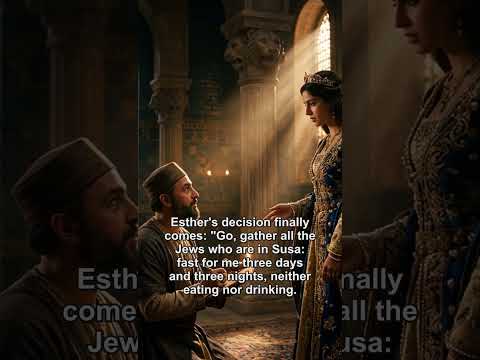
16“Haz que todos los judíos de Susa se reúnan y ayunen por mí. No coman ni beban nada durante tres días y tres noches. Yo y mis doncellas también ayunaremos. Después iré a ver al rey, aunque sea contra la ley, y si muero, que muera”.

17Mardoqueo fue e hizo todo lo que Ester le había dicho que hiciera.

📖 Chapter study

Summary

Mordecai, in deep mourning, asks Esther to intervene with the king to save her people. Esther fears for her own life, since appearing before the king unsummoned could mean death, but Mordecai convinces her with a line that has become famous.

Explanation

This is the emotional turning point of the book. Esther faces a real dilemma: reveal her Jewish identity and risk her life, or remain silent and safe while her people are exterminated. Mordecai responds with one of the most striking lines in the Bible: 'who knows whether you have not come to the kingdom for such a time as this?'—suggesting that positions of privilege or influence may serve a greater purpose than personal comfort. Esther decides to act, but first asks everyone to fast for her, showing that even though the book never mentions God, the people still turn to spiritual practices of dependence on him in the face of danger.

Fun facts

  • Esther's line 'if I perish, I perish,' spoken as she decides to risk her life, echoes the same spirit of total submission found in other biblical figures facing extreme decisions of faith.
  • The three-day fast Esther requests, with no specific mention of prayer, is the closest the book comes to an explicit religious practice, suggesting a spirituality that is present but understated throughout the narrative.

Verse-by-verse explanation

  1. Ester 4:1Mordecai reacts to the decree with the traditional signs of deep mourning: torn clothes, sackcloth, ashes, and a loud, bitter cry that he makes a point of expressing publicly through the streets.
  2. Ester 4:2Even with normal access to the palace, Mordecai is barred from entering because he is dressed in mourning, a rule of court etiquette that leaves him standing outside.
  3. Ester 4:3Mordecai’s reaction repeats on a far larger scale: Jews throughout the empire fall into collective mourning as soon as news of the decree of extermination reaches them.
  4. Ester 4:4Esther only learns something is wrong through her own attendants, and her first reaction is to try to solve the problem practically, sending ordinary clothes to Mordecai, still without knowing the real reason for his mourning.
  5. Ester 4:5Esther turns to a trusted eunuch, Hatach, to act as go-between and find out exactly what was happening with Mordecai.
  6. Ester 4:6Hatach goes in person to the city square where Mordecai was, serving as a bridge between him and the queen inside the palace.
  7. Ester 4:7Mordecai tells Hatach the whole story, including the specific detail of the silver Haman had offered to fund the extermination.
  8. Ester 4:8Mordecai even sends a physical copy of the decree as proof, along with a direct request that Esther personally intervene with the king on behalf of her own people.
  9. Ester 4:9Hatach returns and faithfully passes on Mordecai’s entire message to Esther.
  10. Ester 4:10Esther replies through the same intermediary, beginning an indirect dialogue between the two that will determine the course of the whole story.
  11. Ester 4:11There was a strict law in the Persian court: whoever entered the king’s inner court without being called could be put to death, unless the king held out the golden sceptre as a sign of pardon. This law is the concrete obstacle Esther must face in order to speak to the king about Haman’s plan.
  12. Ester 4:12Esther’s message, explaining the deadly risk of appearing before the king unsummoned, is carried back to Mordecai.
  13. Ester 4:13Mordecai answers firmly, warning Esther that being queen would not automatically protect her from the decree of extermination, even while hiding her Jewish origin.
  14. Ester 4:14Mordecai tells Esther that if she stays silent, deliverance for the Jews will arise “from another place,” and suggests that perhaps she came to her royal position for exactly a moment like this. It is one of the few instances in the book that hints at a greater force working behind the scenes without naming it: in fact, throughout the entire book of Esther, the word God never appears once, something rare among the books of the Bible.
  15. Ester 4:15Esther replies once more through the same channel, preparing the most important request of the whole exchange.
  16. Ester 4:16Esther decides to risk her own life by going in unsummoned, but first asks that all the Jews of Shushan fast for three days along with her and her maidens. Her closing line, “if I perish, I perish,” sums up the wager she is making.
  17. Ester 4:17For the first time in the story, it is Mordecai who obeys an instruction from Esther, not the other way around, a sign that the roles between the two were shifting in the face of the crisis.

Watch the story of this passage

Videos from our channel that tell what happens in Esther 4.

Chapters

Our apps

Our apps →

Bible in Stories

The Bible told as a story, with audio and videos.

📱 Get the app

World in Stories

True stories of humanity that sound made up.

Feito! Pequenas Vitórias

A light daily routine for people who lose track of the day.